
Malheuresement, mon appareil est deja casse... depuis le troisieme jour. Ca veut dire que je n'ai pas de photos de l'Afrique a partager. Pourtant, j'ai beaucoup d'histoires d'oiseaux ici au Cameroun: les corveaux sont blanc et noir; il y a beaucoup d'estrelids et "tisseurs" dans les champs et petits arbres; j'ai vu 8 perroquets gris (avec leurs queues rouges) a une fois et tres pres de la ville! J'ai deja vu plus de 80 especes et j'ai ajoute 50 especes a ma liste! De toute facon, je suis tres content ici.
I'm here in Bafia for Peace Corps training. That's going well also. Here are some of the highlights bird-wise in this somewhat-rural area:
- Ovambo Sparrowhawk: a small gray falcon
- Vieillot's Barbet: red-headed thick-billed woodpecker-like bird that was making a hole in a tree
- Village, Black-necked and Spectacled Weavers: all noisy, yellow and busy weaving nests.
- Gray-headed Sparrow: sounds very much like a House Sparrow, but has a plain gray head.
- Bronze Mannakin and Black-crowned Waxbill: abundant little finches in the fields
- Coppery, Olive-bellied, Superb and Northern Double-collared Sunbirds: stunning beautiful hummingbird analogs.
Je dois faire un teste en francais maintenant. A bientot!
Wednesday, June 23, 2010

Saturday, April 24, 2010
Dauphin Island AL, April 2010

At High Island, someone I ran into recommended Dauphin Island as a great place to see migrants at this time of year (mid-April). So I decided if I'm going to fly all the way to the Gulf, I may as well check it out. So after a more-or-less two hour flight from Harlingen to Mobile, I rented a car and headed south for about an hour to Dauphin Island. Fortunately, there was a motel there which was very nice and right on the water by a park. Although it was dark when I arrived, the next morning I was up at daybreak and immediately found Red-headed Woodpeckers one block away!

Red-headed Woodpecker
Then I headed to the bird sanctuary where I found many more Red-headed Woodpeckers, along with Downy and Red-bellied. Cardinals were singing enthusiastically, as were Brown Thrashers Common Grackles, Gray Catbirds and Mockingbirds. I also stumbled upon a Chuck-wills-widow on the trail!
 Chuck-wills-widow
On the migrant front, most birds were Red-eyed Vireos. I found 13 species of warblers in total: Northern Waterthrush, Hooded, Prothonotary, Kentucky, Worm-eating, Black-and-White, Black-throated Green, Blue-winged, Tennessee, Orange-crowned, Yellow-rumped, Common Yellowthroat and Ovenbird.

Prothonotary Warbler
No orioles, but one Rose-breasted Grosbeak, one Painted Bunting, several Indigo Buntings and several Blue Grosbeaks. A nice Great Horned Owl greeted me in the afternoon, in direct sunlight and wide awake! Unfortunately, my camera falsely reported that the battery was dead, so I missed that shot!

Northern Cardinal

Common Grackle

Brown Thrasher

Red-bellied Woodpecker
On day two, I birded the island a bit more. Semipalmated Sandpipers and Plovers were in a small wetlands area along with Dunlin, Willet and Reddish Egret. Not finding much else at the sanctuar (Black-throated Green and Blue-winged Warblers), I took the ferry across to Bon Secour NWR. There I found some Sandwich Terns, American Avocets, and in the pine woodlands a Pileated Woodpecker, Brown-headed Nuthatches, Eastern Towhees and an Eastern Bluebird. All in all, I got 103 species of birds for my Alabama state list in only two days, and the weather and scenery were stunning. It was a great trip!

Eastern Bluebird
Rio Grande Valley, April 2010
 Plain Chachalaca
After a nice week at High Island, I spent 6 more days on the Gulf Coast, starting with 4 days in the Rio Grande Valley (racking up 189 species!) and then flew over to Mobile to spend another couple of days on Dauphin Island and vicinity. All in all, I scored 216 species of birds, several javalinas and an armadillo grazing along the side of the road at Laguna Atascosa!
This was my fourth trip to the Valley, but my first time on South Padre Island. I was really impressed with the number of migrants at the conference center at Sheepshead, and afterwards touring a few vacant lots that scored a Clay-colored Sparrow and the birding center where I saw a Say's Phoebe and some close-range Clapper Rails! Santa Ana and Laguna Atascosa were fantastic as always, and I got a few firsts: a Common Nighthawk sleeping on a telephone wire, a Willet on a fencepost, and a Greater Roadrunner in a tree!
Here are a few photos by location: First, some farmland near Santa Ana (which was completely flooded due to recent heavy rain) where I saw American Pipits, Horned Larks, Bronzed Cowbirds and Black-bellied Whistling Ducks:
 Bronzed Cowbird
Black-bellied Whistling Ducks
At Santa Ana, migrants were slow. I did get a Yellow-billed Cuckoo, an Ovenbird and White-eyed Vireos along with the usual suspects (Olive Sparrow, Green Jay, Black-crested Titmouse, Ringed Kingfisher, Greater Kiskadee). I also got to photograph a beautiful Sora in the marsh as a Border Patrol helicopter made a lot of noise overhead...
 Great Kiskadee
 Sora
SoraAfterwards, I headed to Bentsen State Park where I got Altamira Oriole and White-tipped Dove. At Hidalgo, I also managed to snag a Black Phoebe at the birding center. That evening, I headed to South Padre where the real action began: Baltimore Orioles, Orchard Orioles, Painted and Indigo Buntings, Scarlet and Summer Tanagers, scads of Northern Parulas with Tennessee, Hooded, Yellow-throated, Blackpoll, Cerulean, Nashville Warblers, Northern Waterthrush, Yellow-breasted Chat, White-eyed, Warbling, Philadelphia and Red-eyed Vireos. Also present were Yellow and Black-billed Cuckoos!
 Indigo Bunting
 Scarlet Tanager
 female Hooded Warbler
 Baltimore Oriole
Poking around South Padre Island, a new friend and I managed to find an Upland Sandpiper, Black-crowned Night Heron, Inca Dove and Clay-colored Sparrow, along with a beautiful Tennessee Warbler (along with Swainson's Thrush, Eastern Phoebe and a few other goodies).
 Upland Sandpiper
 Tennessee Warbler
 Northern Parula
 Orchard Oriole
 Black-billed Cuckoo
The shoreline was stuffed with terns and shorebirds. Least, Sandwich, Royal, Caspian and Forster's Terns, Franklins and Laughing Gulls, Snowy Plover, Black-bellied Plover and Semipalmated Plovers among them. And of course, Black Skimmers!
 Black Skimmer
Before heading to the airport, I hit the boardwalk and found Clapper Rail, Reddish Egrets, Tricolored Heron, Say's Phoebe, White-rumped, Semipalmated and Spotted Sandpiper, Long-billed Dowitchers and Dunlin. And a Belted Kingfisher also.
 Clapper Rail
 Reddish Egret
 Greater Roadrunner
 Painted Bunting
 Green Jay in the parking lot!
 Clapper Rail
 Reddish Egret
Laguna Atascosa was the final stop before the airport. Highlights included Philadelphia Vireo, Painted Bunting, Harris Hawk, Long and Short-billed Dowitchers and a White-tailed Hawk that I unfortunately did not manage to photograph. Also unfortunate was a miss on the Aplomado Falcon...
 Greater Roadrunner
 Painted Bunting
 Green Jay in the parking lot!
That was it for the Rio Grande Valley for this trip. More on Alabama birding the next post!
Wednesday, April 14, 2010
High Island, TX April 2010

I just got back from a quick weekend on the Texas coast. This trip wasn't as successful as last year, but I did manage to snag 128 species of birds, get my first-ever photos of King Rail and Least Bittern and have a great time.
The songbirds appear to be around two weeks late leaving Mexico. Evidently, there was a cold front that reached to the Yucutan, and that was why the numbers weren't there. Additionally, the mulberries were mostly still green, accounting for surprising misses on Rose-breasted Grosbeak and Baltimore Oriole.
Some good birds were seen, however. Prothonotary Warblers were fairly numerous, and in addition to scads of Yellow-rumped "Myrtles", I saw several Swainson's, Worm-eating, Orange-crowned, Northern Parula, Hooded, Louisiana Waterthrush and Palm Warblers. (Three of those are pictured above!) Vireos included Yellow-throated, White-eyed, Warbling, Red-eyed and Blue-headed. Scarlet and Summer Tanagers were both numerous, as were Indigo Buntings. Others saw Painted Buntings as well. Mostly, the warblers were low in both number and variety (no Nashville, American Redstart, Chestnut-sided or several other "common" warblers had been seen yet this year as of 4/11).
The waders and shorebirds were as good as last year. Least Terns were numerous, although oddly there were very few Brown Pelicans on the Bolivar Peninsula (that I could see, anyway). My group missed the Yellow and Black Rail at Anahuac NWR, but they had been seen earlier in the day. Our compensation: Least Bittern, American Bittern, King Rail, Clapper Rail, Sora, Seaside Sparrow and Mottled Duck. In reality, Least Bittern was the treat. Sadly, the light was very poor for a photo. But as my first-ever photo of this bird, it's acceptable...

Tuesday, December 29, 2009
Puerto Rico, December 2009

La Pared at Luquillo
I just got back from Puerto Rico, where I spent Christmas holiday both enjoying the island and of course looking for birds! Anyone who knows me realizes that I love to travel and I love birds. Although I would probably go anywhere at the drop of a hat, I choose destinations more carefully than it might appear. For example, in this case I really wanted to go to a place where it was warm in December (check), there were birds I hadn't seen before (17 endemics plus a few eastern Caribbean specialties), it wasn't a SUPER long flight (8 hours, still closer than Africa or S.A.), and it was safe to rent a car and drive around (check). Plus, I don't want to bird every waking moment... there is also snorkeling and swimming and kayaking and some interesting sights and scenery as well.
All in all, it was a great vacation. We stayed two nights in Luquillo on the northeast coast and four nights near Guanica at the southwest coast. Luquillo is near El Yunque, or Caribbean National Forest, last refuge of the Puerto Rican Parrot. (It also is a popular surfing destination.) The habitat here is tropical rain forest. Guanica is on the dry side of the island, with an interesting biome that hosts the Puerto Rican Nightjar (found nowhere else on earth). It is also near Maricao, another tropical rain forest refuge, and home to the Elfin Woods Warbler... a black and white warbler only discovered (or as we decided, "noticed") in 1971.
Skipping the narrative, here is the trip summary:
Total Species Seen: 70
Life Birds: 20 (several I had seen in Jamaica or Abaco, but it was the first "serious" trip to the eastern Caribbean)
Endemics Seen: 14 of 17!! Puerto Rican... 1. Vireo, 2. Pewee, 3. Nightjar, 4. Flycatcher, 5. Bullfinch, 6. Lizard Cuckoo, 7. Tody, 8. Tanager, 9. Emerald, 10. Woodpecker. Plus, 11. Elfin Woods Warbler, 12. Adelaide's Warbler, 13. Yellow-shouldered Blackbird, 14. Green Mango.
Best Bird of the Trip: Elfin Woods Warbler. This was a fairly easy find off the highway to Maricao, and the very top of the ridge. The books said they hang around Puerto Rican Tanagers, so once I saw a flock of those in an orange tree, I only had to wait 10 minutes for a little black-and-white warbler to show up close to them. A cutie-pie, and pretty rare too. I did get a photo of the tanagers, but the warbler was too fast for me.
Best Location: Bird-wise, the visitor's center at El Yunque. I just walked up and saw a Black-cowled Oriole and Scaly-naped Pigeon fly by a Loggerhead Kingbird. I also got my awesome shots of a Puerto Rican Lizard Cuckoo!

Best Migrant: The best find (for a Pacific Coast bird-gal) was a Prairie Warbler in the scrub near the Copamarina Beach Resort. The runner-up would be a Stilt Sandpiper in a shorebird pond at San Jacinto, right next to the same hotel. There were not many migrants other than the many shorebirds in this pond, which I found a bit surprising.

Best Photo: Pearly-eyed Thrasher. I'm not much of a fan of this bird since they raid other birds' nests and eat their eggs. They also refused to allow me to photograph them until literally the last moment of the trip, just as we were checking out of our hotel. Then two of them hopped up on the ground and waited for me to snap this shot before flying off for good.
 It was too tempting to resist :-)
Most (Seemingly) Photogenic Bird: Puerto Rican Tody. These little guys represent a unique family of birds, confined to only the Greater Antilles. They are related to kingfishers, and do sort of resemble them, but amazing (and Christmas-sy) colors and they make an adorable (and readily memorable) buzz as they fly around above you. I was tempted to photograph every one I saw, just because they had so much character. Too bad they are always in the shade and moving quickly, else some of those might have come up :-P

Biggest Camera Hogs: Gray Kingbird. Not only are they incredibly common (especially near Guanica), but at times they were even chasing away birds I was trying to photograph and took over their branch! Here is one posing with a Troupial, who seems to be looking at him in dismay.

Annoying Bird of the Trip: There were a few contenders, but I have to say hands down that it's the Bananaquit. Don't get me wrong. They are cute. They have a nice song. But there are more Bananaquits than any other type of bird in El Yunque. Plus, they have many calls and MANY songs. Holy cow. I might have even missed the Puerto Rican Spindialis just because I started tuning out any bird with a yellow underside, black head, white eyebrow. Which the Spindialis also has. That was my excuse anyway, for the only common bird I missed. :-(

Highlights (non-bird-related): This is a completely unsolicited plug. The churrasco at Guava's in Luquillo (near La Pared) is to die for. This was soooo good, we went back the second night and I had it again.
Lowlights: John had some issues staying on his kayak. I'll let him explain in his own blog :-)
Other Photos: A few more just because I liked them :-)
White-cheeked Pintails, enjoying an early morning swim at San Jacinto. This is a little pond next to the Copamarina Beach Resort, in Guanica Dry Forest.

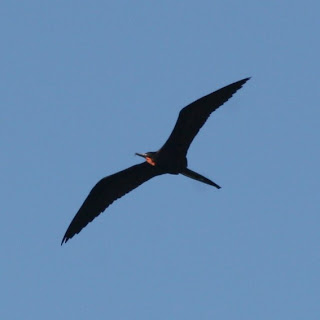
One of many Magnificent Frigatebirds soaring above Puerto Rico. This male was flying over the Copamarina Beach Resort.
An Adelaide's Warbler. This shot was taken at San Jacinto, next to the shorebird pond.

A Puerto Rican Woodpecker, interrupted from his loud calls in front of the Copamarina Beach Resort one morning.

A Zenaida Dove, showing off his colors at a park in Carolina.


Finally, the Puerto Rican Tanager. This is not a very good shot, but I had to include it out of respect for the species... they led me to the Elfin Woods Warbler. This was even taken moments after that event, and he almost seems to be saying "You're welcome" :-)

White-cheeked Pintails, enjoying an early morning swim at San Jacinto. This is a little pond next to the Copamarina Beach Resort, in Guanica Dry Forest.

One of many Magnificent Frigatebirds soaring above Puerto Rico. This male was flying over the Copamarina Beach Resort.

An Adelaide's Warbler. This shot was taken at San Jacinto, next to the shorebird pond.

A Puerto Rican Woodpecker, interrupted from his loud calls in front of the Copamarina Beach Resort one morning.

A Zenaida Dove, showing off his colors at a park in Carolina.

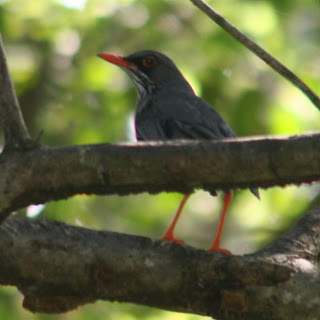
A Red-legged Thrush at the same park in Carolina.

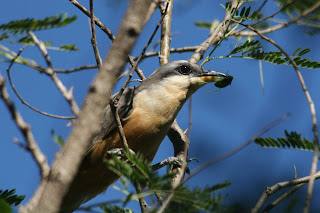
A Mangrove Cuckoo, holding what appears to be a grasshopper (though I'm no entomologist). This shot was taken early morning in the Guanica Dry Forest.

A Black-faced Grassquit by the side of the road in San Jacinto. These were so common I at first though they were some sort of escaped cagebird. But they are indeed native to these islands.


Sunday, July 12, 2009
Marrowstone Island Saturday

Long story short: I spent a warm, sunny Saturday (probably 75-80° F) looking for birds around the eastern Olympics. The reason: last week, I decided to write the fall destination article for Seattle Audubon's Earthcare on that area. I had had a lot of luck in the past with the Protection Island cruise and nearby Fort Worden during that time of year, so Port Townsend and vicinity seemed like a good idea.
While writing the directions, though, I notice this big island immediately to the right of Port Townsend. Marrowstone Island. It looks like great habitat, has a big state park (Fort Flagler) on the north end of it, and I'm suddenly intrigued enough to want to check it out.
Anyway... the directions from maps.bing.com for Fort Flagler were pretty good. Except for how it ends: "if you reach Flagler Campground Rd, you've gone too far". OK, obviously if you go too far, you end up in Puget Sound.
I must say though, mid-July was probably not the greatest time to go. I think winter or migration (read: any other time) would be better! Yet you definitely have a couple of interesting features. First, there's a pretty dramatic current off the beach on the east side of the park. It wasn't exactly stuffed with birds, but it was very close to shore (a scope help but isn't necessary), and there were a heck of a lot of Pigeon Guillemots diving and sloshing and playing around in that current. They float from one end to the other, and then fly back to the north end. There were a lot of gulls bobbing there as well (though sadly I didn't bother IDing them), though I was a bit surprised not to see any other species.
But anyway, the second thing is, the island just looks adorable. The tiny inlets and harbors full of boats are so picturesque. Plus, there seems to be great access to the coastline from all over the island and every direction, so I can see it will be really good to know about this place during shorebird migration!
My list for Fort Flagler today: ubiquitous Swainson's Thrush heard singing. Several Brown-headed Cowbirds being fed by their Song Sparrow foster-parent. American Goldfinches potato-chipping among the big leaf maples overhead. A lot of American Robins, Barn and Violet-green Swallows.
Yet this is the way it always goes for me: at the Edmond's Ferry Terminal at 8:40am, on my way to where I was going (and practically still in Seattle), I had pretty much every interesting bird of the day in one raft: Pigeon Guillemots displaying at each other, Rhinocerous Auklets hanging around a single Cassin's Auklet. A pair of Marbled Murrelets a bit farther out. Several fly-overs by Heerman's Gulls, and at least one Bald Eagle fly-over as well. Go figure!
Friday, July 10, 2009
Welcome!
This is a site I set up mostly to share my travel and birding stories and commentary. More stuff, including my April High Island Texas trip and the latest from the Olympic Peninsula will be coming soon!
Subscribe to:
Posts (Atom)